Block 02 · 01
The Stock Market
How the planet's main financial conveyor works: stakes in real businesses, price growth, and dividends.
Price appreciation
- What actually happens
- Revenue, profit and assets grow — the market reprices your stake upward. You collect the money when you sell.
- How the result reaches the investor
- While the position is open the result stays on paper: it moves with the quote and is realised only by a trade.
- The form the result arrives in
- Paper gain until you close
Step by step
- 1BusinessThe company earns more than a year ago
- 2ValuationThe market revises what the stake is worth
- 3QuoteThe share price follows that valuation
- 4RealiseIt becomes money the moment you sell
Both sources run at the same time and don't cancel each other out. What matters is the mechanics: appreciation is realised by a trade, dividends arrive as cash. The actual outcome depends on the company and the period.
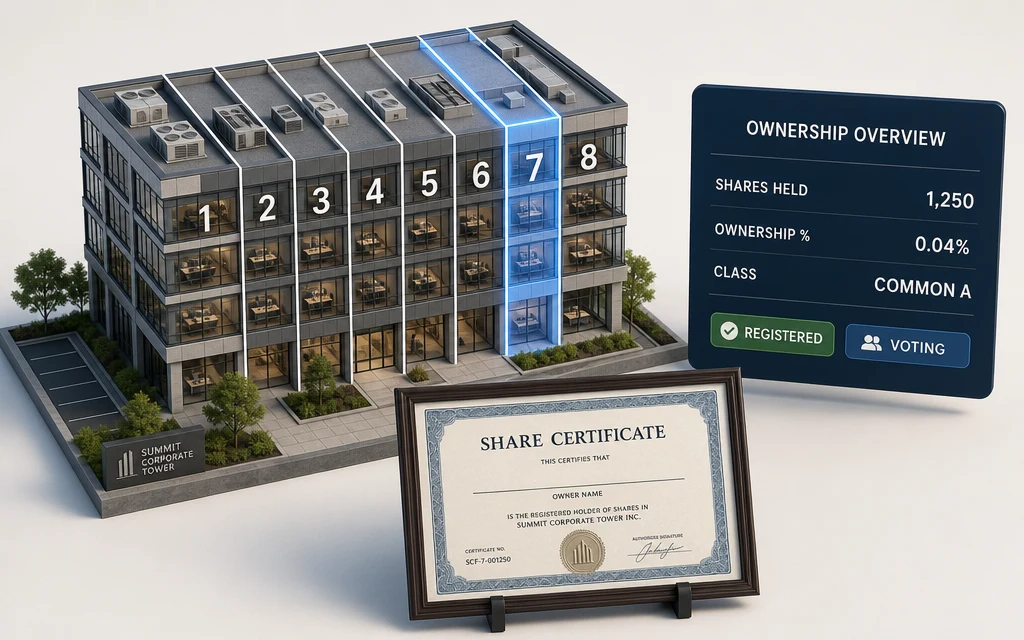
A whole company is worth a certain amount. That amount is split into equal parts — shares. Buying a share makes you the owner of one such part.
Buying a share means buying a stake in a company.
Technology
32%
XLK · index weight
- How it makes money
- Software, chips, cloud. Build the product once, sell it to millions.
- Who's inside
- Microsoft · Apple · Nvidia
- How the return arrives
- Capital appreciation, token dividends
- When it works best
- Accelerates when money is cheap and the economy grows
The US market isn't one chart. It's eleven different business machines: when one stalls, another accelerates. That's why capital never buys 'stocks in general' — it picks a sector.
In plain words
Here's how it works in plain terms. There's a coffee shop on the corner. It earns $100,000 of profit a year, and the owner splits it into 1,000 equal shares — $100 each. You buy ten shares for $1,000, and from that second you own one percent of the business. Then it gets interesting. The shop opens a second location, revenue climbs, profit doubles to $200,000. Your stake didn't change in size — its price did: now it's worth $200. On top of that, at the end of the quarter the owner wires you your part of the profit, simply because you're a co-owner. The stock market is exactly that coffee shop — except instead of a street corner it's Microsoft, Visa, and Exxon, instead of 1,000 shares it's billions, and instead of a conversation with the owner there's a button in a terminal that transfers the stake to you in two seconds.
The market is not a virtual game and not numbers in an app. It's the planet's main financial conveyor. When giants like Microsoft, Apple, or Exxon need billions for new plants, R&D, and market share, they don't take expensive loans — they sell stakes in their business. Buying a share isn't placing a "bet": you legally acquire a real piece of that business machine and become a co-owner alongside billionaires and multinational funds.
So where does the money come from? The mechanics are perfectly transparent. Picture a business building new logistics centers, growing revenue, and taking market share. The fundamental value of its assets rises — which automatically makes your legal stake more valuable. On top of that, the company regularly takes part of its net profit and transfers it to your account as . You earn twice: on the growth of the business itself and on the distribution of its real cash flow.
Why does professional capital always keep its core in equities? This instrument has no ceiling. With loans and interest your return is capped in advance, while a real business can grow many times over, outpacing inflation for years — because corporations simply pass rising costs on to the end consumer and keep their margin. Meanwhile every share you own is strictly recorded at the central , and you can sell your stake and take the money out in live cash at any second — the market is fully liquid.
Try it yourself
What a stock's move brings at different leverage
Risk management — 20% of $25,000 in the trade: $5,000
+$0
The trade holds $5,000, position $25,000 at x5 leverage.
Leverage doesn't change the idea — it only multiplies the result of your decision. Only 20% of capital goes into the trade; the rest is your buffer.
Common beginner mistakes
- Treating a stock as an abstract entry — behind it is a stake in a real business
- Looking only at a single share's price: what matters is market cap and company profit
- Evaluating a company without its financials — revenue and margins give the real picture
- Sticking to one sector when the US market offers access to all of them at once