Block 02 · 02
Bonds and Yield
US government bonds, coupons, yield to maturity, and why prices fall when the Fed raises rates.
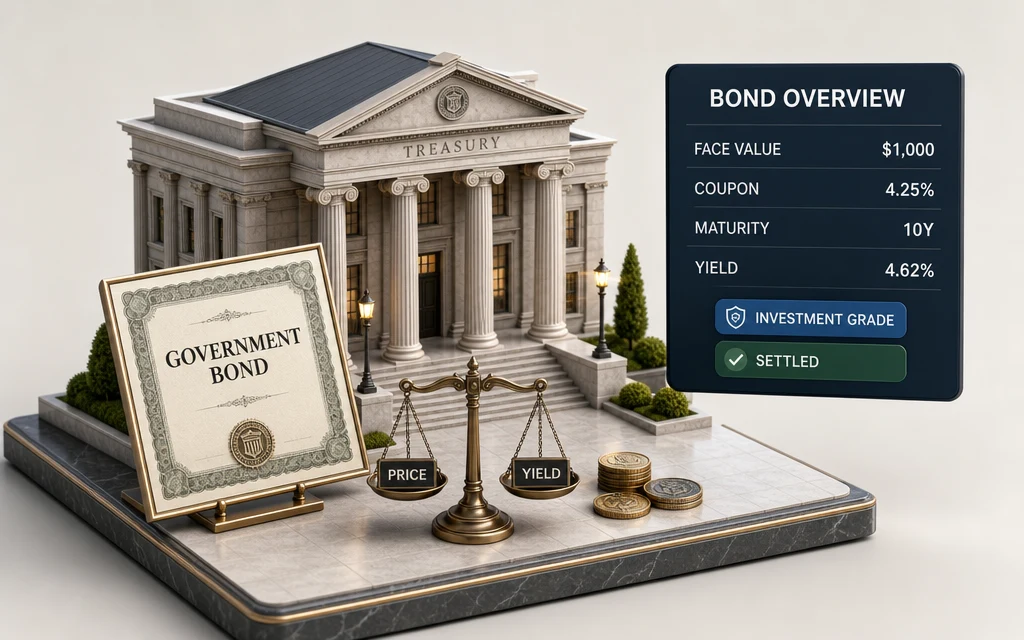
A bond is a payment schedule known in advance. You see the return before you buy.
In plain words
Picture a $1,000 US Treasury issue. You put in that amount and, in exchange, get a promise: twice a year you're paid a coupon — say, $22.50 — and on the set date you get the full $1,000 back. Everything is spelled out in advance in the terms of the issue — amount, dates, rate. This is exactly what makes up the US debt market, worth over $50 trillion, in which pension funds, banks, and central banks from other countries all participate.
A bond is when money is borrowed from you. The borrower is the US government or a large company, and you receive a predetermined interest rate on a set schedule.
The key difference from owning a stake in a business. Everything here is calculated in advance: the amount, the rate, payment dates, and the repayment date. You know your return before you even buy.
Who borrows. The US Treasury is the largest borrower in the world: the money funds roads, defense, and infrastructure. Corporations borrow to build factories and fund development, because it's cheaper than selling a stake in the business.
Why bonds belong in a portfolio. They provide a predictable cash flow that arrives regardless of how the stock market moves, and they act as an anchor for your capital: part of the portfolio always works at a fixed rate.
Try it yourself
Bond: what a fixed rate earns on your amount
$0
Principal $10,000 + $2,500 of income — at a fixed rate for the whole term.
A bond is a rate fixed for the whole term, not a bet on price swings. Move the amount, rate and term — the income updates instantly.
Common beginner mistakes
- Calculating yield from the coupon alone, without accounting for the purchase price
- Ignoring the maturity date: it determines when your money comes back
- Not watching the Fed's rate — it sets the level for new issues
- Holding only one maturity when payments could be spread across several years