Block 02 · 06
What Is an ICO
How crypto projects sell tokens, how it differs from an IPO, and why fraud is most common here.
The primary market is an entry into a company's story at its earliest public stage.
An ICO is the moment a project offers its token to the market for the first time. An investor gets access to the project before a full public market has formed around it.
- 01
A new project or idea
- 02
The project needs capital
- 03
A token is issued
- 04
Investors get the chance to enter at an early stage
- 05
The project develops
- 06
The market forms the token price
Hypothetical example
Illustrative position: 10,000
An early stage can create significant upside potential if the project develops and the market forms a higher token price.
An ICO gives an investor access to a project before a full public market has formed around it.
How a token differs from a share
A share is a stake or a right in a company.
A token is a digital asset of a project.
The example is entirely hypothetical. It is not investment advice and not a promise of returns.
In plain words
Look at Ethereum. In 2014, the network existed only on paper: the team described building a platform where programs run automatically, and sold the ETH token to raise money for development. ETH wasn't meant as a stake in a company — it was fuel: every operation on the network runs on it. Today, that platform hosts stablecoin issuance, settlement services, and tokenized funds from major asset managers, and ETH remains an essential part of how it operates. A token is access to infrastructure, not an entry in a shareholder registry.
An is the sale of a digital . A project issues a token and offers it to investors to raise capital for building its network or service.
How a token differs from a stock. A stock is a stake in a company. A token is the right to use a product within an ecosystem: paying for transactions on the network, voting on protocol upgrades, or accessing a service.
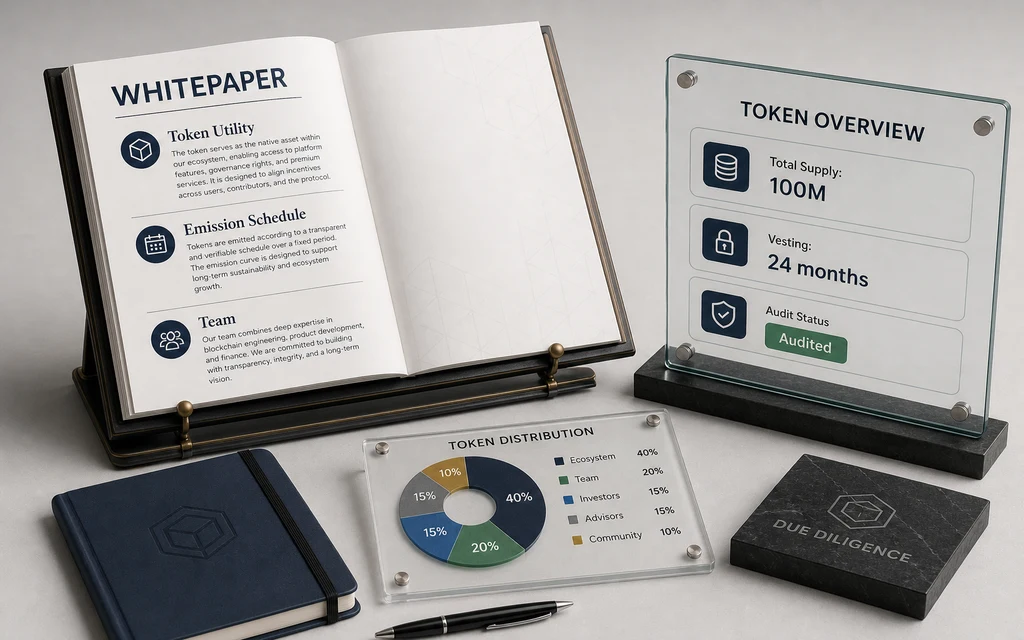
How it works. A project publishes a technical document — the — covering what's being built, the token's role, how many tokens are issued, and how the capital is allocated. The token is then sold and starts trading on platforms.
What professionals look at. A working product and network activity, a public team, a audit from a reputable firm, and a clear token distribution schedule. This is how networks like Ethereum and Solana grew out of early token sales — networks the entire digital asset industry now runs on.
Try it yourself
ICO: buying tokens in the presale and the price after listing
$0
You get 40,000 tokens; x4.0 against the amount invested.
In an ICO the entry price is fixed upfront and the market prices the token only after listing. The whole result is the spread between the presale price and the first market price.
Common beginner mistakes
- Treating a token as equivalent to a stock — their functions differ
- Participating in a sale without reading the whitepaper
- Not checking for a smart contract audit from an independent firm
- Ignoring the vesting schedule and token distribution structure