Block 02 · 07
Exchange Contracts
The top tier of the market: joint deals with US funds where the entry amount, the income and the term are fixed in advance.
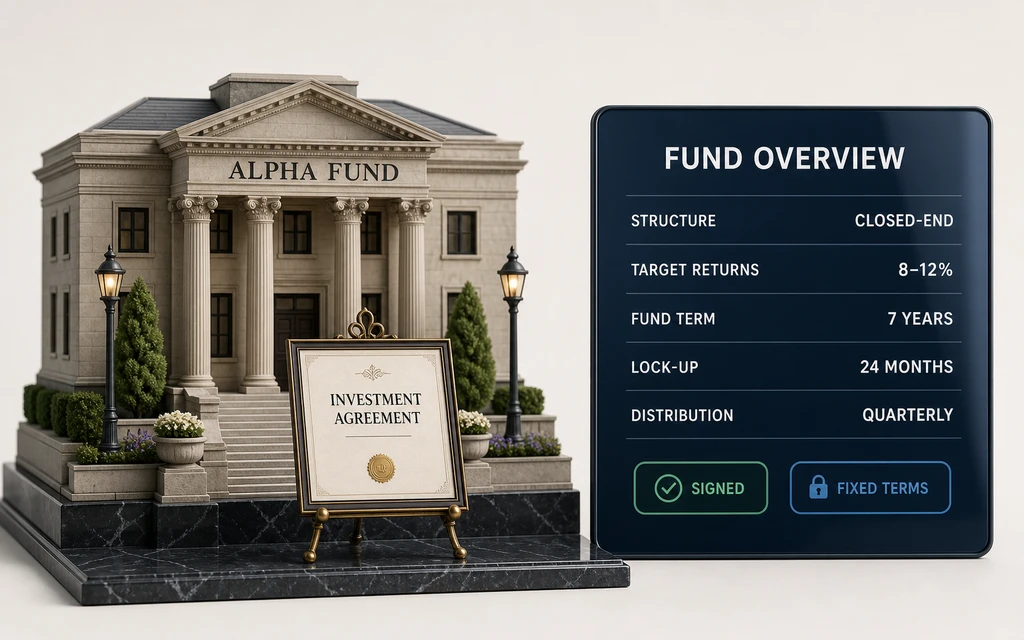
A hypothetical example. A contract fixes the terms of a deal between the parties: what, how much, at what price and when.
The asset the deal is about.
The economic interest of both sides
The buyer gets the ability to acquire the goods on agreed terms.
The seller gets the ability to sell the goods on agreed terms.
The fund's participation
- 01
Fund
- 02
Takes part in the deal
- 03
Receives an economic result
Such an operation makes economic sense not only for the client: the fund also earns a result from its activity and its participation in deals like this.
All figures in the example are illustrative and serve to explain the structure of a contract. The outcome of a deal is not guaranteed.
In plain words
It is like joining a major development project alongside an institutional investor: you know your share, your contribution, the build timeline and the payout in advance, instead of buying an apartment on the open market and hoping prices rise.
What it is
An is a joint deal with a large US fund. You choose how much you put in, the fund runs the position, and at the end of the term it pays out the profit.
How it differs from an ordinary purchase
- Ordinary stock purchase: the result depends on the market and is unknown in advance.
- Contract: the , the income and the term are known before you enter.
What you get
- Entry into a deal at the same level as the largest funds.
- Clear terms: how much you put in, how much you receive and when.
- Transparency: every parameter is fixed and backed by infrastructure.
Why it is not available to everyone
These positions are not handed to the mass market. They go to vetted companies and s. That is why taking part in a contract is a rare event and a matter of standing, not just a button in an app.
In plain words: you invest into a deal together with a fund, and the fund returns your principal plus the profit agreed in advance.
Try it yourself
Exchange contract: entry amount, fixed rate and term
$0
Payout $59,000: the principal plus $9,000 of income, about $1,286 per day.
Contract terms are fixed upfront: participation amount, income and payout date. The calculation shows the agreed outcome, not a market forecast.
Common beginner mistakes
- Treating a contract like an ordinary trade and ignoring the fixed payout date
- Entering with money you need before the contract closing date
- Agreeing to a "contract" without transparent written terms and infrastructure confirmation