Block 03 · 01
Types of Exchanges: Dollar ↔ Crypto and Brokerage Funding
Coinbase, Kraken, Cash App, PayPal, P2P, and OTC: how to move dollars into crypto, fund your brokerage account, and withdraw without losses.
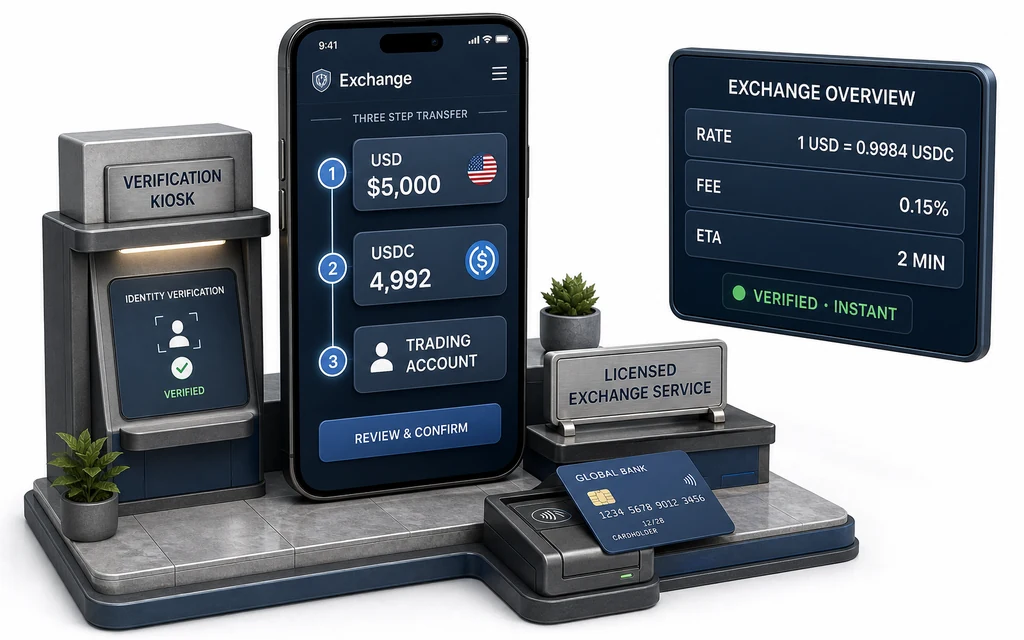
Primary route — via a crypto exchange
Four main funding options
A stablecoin designed to hold a value near $1.
01 · Buy crypto
- What happens
- On a crypto exchange you convert dollars into the chosen asset.
- What to check
- That the account is verified and the payment method is genuinely yours.
- Where a fee appears
- The exchange purchase fee, and possibly a payment-processor fee.
Alternative route — bank wire
A wire transfer uses the bank details of partner companies and stays separate from the crypto route: different timing, different confirmations.
The crypto-exchange route is the primary funding path. A wire to partner bank details exists as a separate alternative.
Crediting times and final amounts depend on the network and venue and are not guaranteed.
Withdrawal takes the same route in reverse: USDC → dollars → your bank account.
In plain words
Compare two transfers of the same amount, say $10,000. A classic international bank wire: business days only, a flat fee from the sending bank, a fee from the intermediary bank, an in-house conversion rate, and funds arriving in two to three days. The USDC route: the same $10,000 converts into a digital dollar at the market rate, arrives in your trading account within minutes — including weekends — and total costs run to a fraction of a percent. The amount is the same, the purchasing power is the same — only the speed and cost of logistics differ.
Funding your account means converting your dollars into digital form and crediting your trading account. It takes minutes and works any day of the week.
What is. It's a digital dollar: one token always equals one dollar. It's issued by a regulated US company, and reserves are held in cash and short-term US Treasury securities, confirmed by regular reporting. Your balance doesn't move with the market — a dollar stays a dollar.
The route is simple: dollars from your bank account → converted to USDC → credited to your trading account. Withdrawals follow the same path in reverse, and the money lands in your bank account.
Why this is convenient. Costs along the route amount to a fraction of a percent — noticeably better than traditional international transfers. There's no volume limit: the route works the same way for your first few hundred dollars and for large sums. At every step you can see exactly how much will be credited.
Common beginner mistakes
- Looking only at the fee without accounting for the spread in the rate
- Funding the account from someone else's accounts — deposits must come from your own
- Sending a transfer without double-checking the address and network
- Using the same route for any amount: larger volumes get better terms