Block 02 · 05
What an IPO Is
How a company goes public in the US, who profits from the offering, and what risks a beginner faces.
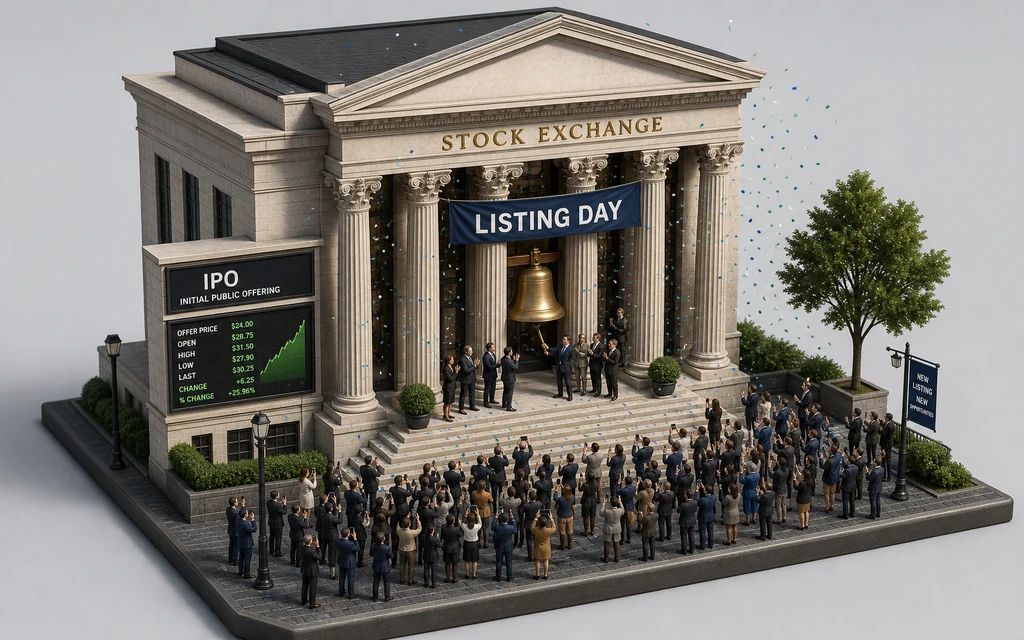
The primary market is an entry into a company's story at its earliest public stage.
An IPO is a company's move from private ownership to the public market. Tap any stage to see what happens there.
The company is owned by its founders and existing investors.
Founders, early investors, management.
Shares are not traded on an exchange and are out of reach for the broad public.
The core of an IPO is not the listing day itself but the change of status: the company becomes public, its reporting is open, and the share price is set by the market.
Educational example. Not investment advice.
In plain words
Take Visa. Until March 2008, it was a private structure owned by member banks. Then the company completed what was, at the time, the largest offering in US history: it sold shares on the public market, raised capital to grow its payment network, and committed to publishing quarterly results. From that day on, any investor with a brokerage account could become a co-owner of a payment system that handles a substantial share of the world's transactions. That's an IPO — the moment a private business becomes accessible.
An is the day a private company first brings its shares to an exchange, and any investor can become a co-owner.
What happens before that. The company grew on money from its founders and private funds. Access was limited to a narrow circle. To raise capital for scaling up, it goes public.
What going public provides. The company gets money for factories, development, and expansion, and along with it, public reporting, audits, and SEC oversight. The business becomes transparent — every quarter, it shows everyone its revenue and profit.
Why this matters to investors. An IPO is an entry point into a company at the start of its public life. That's exactly how access to Apple, Amazon, and Visa first opened up — ordinary offerings at the time, and now among the largest companies in the US market.
Try it yourself
IPO: how much capital to commit and what day-one growth gives
+$0
$4,000 of capital is in the trade, $16,000 stays free.
Even on a strong idea, not all capital goes in — the share is set by risk management in advance, not by emotion after the stock has already moved.
Common beginner mistakes
- Not reading Form S-1, even though all the figures are published in advance
- Evaluating an offering without comparing it to companies in the same sector
- Ignoring how the raised capital will be used
- Not accounting for the lock-up period when planning your horizon