Block 01 · 01
What Is a Stock Exchange
In plain terms: a place where those who want to buy a share of an asset meet those who want to sell it. And why the whole economy runs on it.
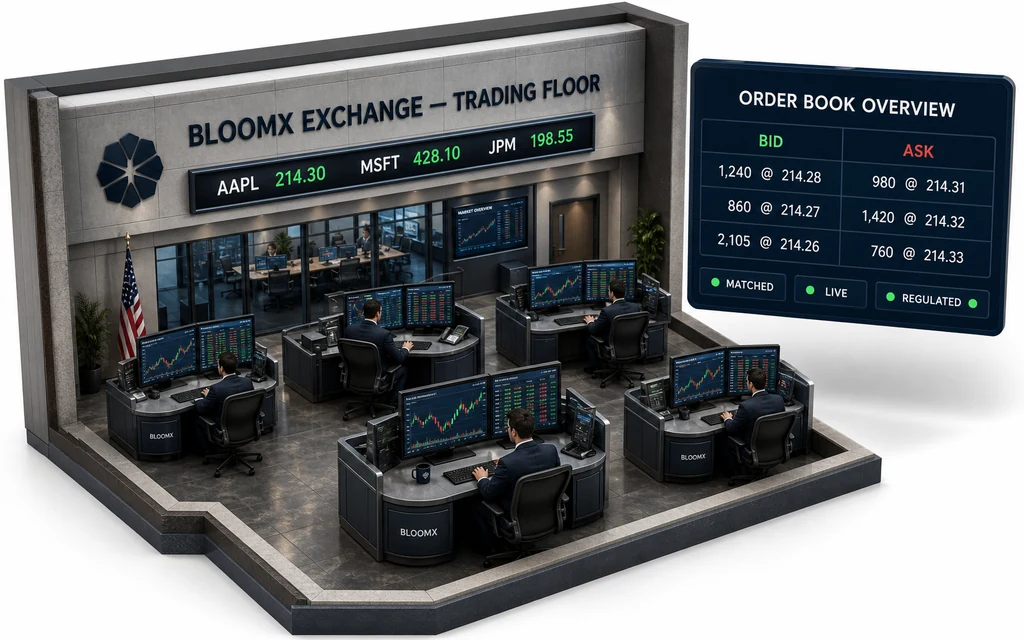
The exchange trades more than stocks: bonds, funds, commodities, currency. Any of these assets takes the same path — from a buyer to a seller.
Companies get capital
Money funds plants, R&D, expansion
Jobs are created
New projects mean new teams and paychecks
People's savings grow
Pension funds and private accounts hold these assets
The exchange is the economy's circulatory system: money flows to where jobs and products get created.
You want to buy 10 shares. Below is a simplified order book: the prices others are willing to sell at, and the prices others are willing to buy at.
Sell orders
Buy orders
Choose an order type
What is what here
- An order is an instruction to buy or sell a given quantity on given terms.
- A buyer names the price they are willing to pay; a seller names the price they are willing to accept.
- When the two prices meet, a trade happens and both orders leave the book.
You do not buy a share from the exchange. Exchange infrastructure matches the orders of buyers and sellers.
In plain words
Apple, Coca-Cola, Exxon, Visa — none of them is held by a single owner; each is split into millions of shares. They're held by pension funds, banks, insurance companies, and tens of millions of individual accounts. An exchange isn't a building or a website — it's a system that around the clock matches those who want to sell a stake with those who want to buy one, and makes sure the trade happens fairly. The same thing happens with oil, gold, currencies, and government debt: the logic is identical for any asset that has a price.
What is a stock exchange?
An exchange is an organized market where buyers and sellers of a huge range of s meet. It's not only stocks, as it might seem at first. Company shares, government and corporate bonds, commodities, currencies, funds, and other financial instruments all trade on exchange infrastructure. This is where capital constantly passes from one participant to another.
How does a trade happen?
The exchange's main job is to connect the two sides. One participant wants to buy an asset, another is ready to sell it. The exchange organizes the process, matches the orders, and enforces the rules by which the trade takes place. When a suitable price and volume meet, the trade executes in fractions of a second.
Why does the exchange matter for the economy?
But the exchange's significance goes far beyond simply being able to buy a stock.
Through the market, capital flows into the real economy. Companies go public, raise money from investors, and direct it toward growth: they build factories, open new production lines, develop technology, hire employees, and enter new markets. Money sitting in an investment account today may be working tomorrow inside a company that builds airplanes, manufactures medicines, creates processors, or lays power grids.
That's why the exchange is connected to everything around us every day.
New jobs, business growth, infrastructure construction, technology launches, and new products all require capital. The market creates the mechanism through which that capital can get to where it's needed for growth.
What happens with real assets?
At the same time, the exchange doesn't work only with companies.
It's where the value of an enormous number of real resources is determined. The price of oil changes with global . The price of gold responds to the state of the world economy, inflation expectations, and central bank actions. The price of copper reflects industrial demand, because it's essential for power grids, construction, electronics, and manufacturing.
In other words, the price you see on the screen isn't an abstract number. Behind it stand real enterprises, factories, logistics, energy, raw materials, and millions of decisions made by people and companies.
How does an individual investor get onto the exchange?
A helps an individual investor access this market. You open a brokerage account, choose the asset you want, and send an order. The broker routes it to the appropriate trading system, where it meets an order from the other side. After the trade executes, ownership of the asset is recorded in the accounting system.
You don't need to find a person willing to sell you an Apple share or call a bondholder to negotiate a price. All of this infrastructure works automatically.
Why you shouldn't fear the exchange
That's why an exchange shouldn't be seen as a casino or an obscure place where people just click Buy and Sell. It's capital-redistribution infrastructure where the interests of businesses, governments, funds, banks, and individual investors meet.
And the better you understand the exchange, the clearer the rest of the financial market becomes.
Stocks, bonds, commodities, funds, earnings reports, interest rates, technical analysis, and investment strategies — these are all separate elements of one large system that starts with a simple principle:
capital must be able to flow to where it can work and create new value.
Common beginner mistakes
- Fearing that the exchange is something complicated and not for ordinary people — in reality, it's simply a place where those who want to buy meet those who want to sell
- Thinking you need to understand everything at once before starting — you'll learn the details gradually, step by step
- Treating buying a share as a blind bet — in reality, you're becoming a part-owner of a real business, not playing a guessing game