Block 05 · 04
Portfolio Diversification
Why you shouldn't hold everything in one stock, and how diversification lowers risk.
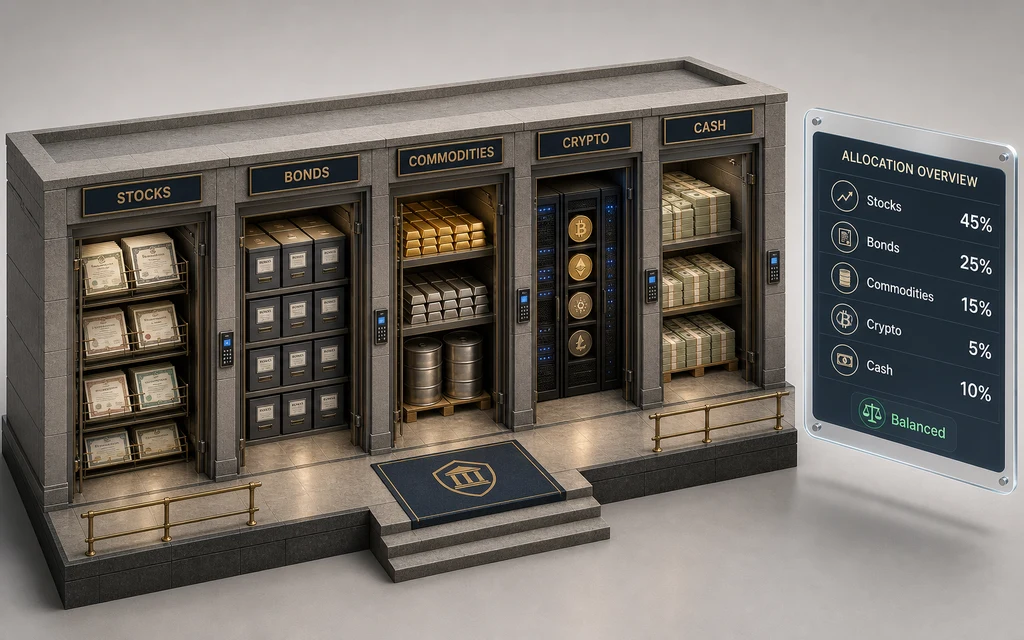
You have $100,000. How would you spread it across different market directions? Move the sliders — the total always stays at 100%.
One of the most dynamic segments of the market.
A strong market direction.
Currently in a correction.
Showing good momentum.
Your capital is distributed across four different market directions.
Diversification means spreading capital across different assets or market directions instead of betting on a single one.
Educational example. Not investment advice.
In plain words
Look at a specific $50,000 portfolio. The investor holds 40% in tech stocks — growing on demand and new products. 20% in energy — reacting to weekly EIA data and production decisions. 25% in US Treasury bonds yielding 4.8% annually — the coupon is known years in advance and arrives regardless of what's happening in the stock market. 15% sits in cash, waiting for an entry point. Over the quarter, tech consolidates, energy trades off oil data, and bonds pay their coupon on schedule. The portfolio keeps working the whole time — just through different parts.
means spreading capital across different sources of return. The point isn't to hold as much as possible, but to have each part of the portfolio work on its own logic.
What this looks like in practice. The tech sector grows on demand and new products. Energy reacts to oil inventory data. Bonds pay a fixed coupon known in advance. Three sources of return, three independent mechanisms.
Why this is an advantage. When one sector is quiet, another may be active. The portfolio keeps working in any market condition, and you're always positioned in whichever part of the market is currently moving.
Levels of allocation. By — stocks, bonds, commodities, crypto. By sector within stocks — technology, financials, energy, healthcare. By time horizon — long-term positions and short-term ideas tied to specific dates.
A reasonable number of positions is 8 to 15. That's enough for diversification while still letting you track each position meaningfully.
Try it yourself
$50,000 balance. 30% of it works as margin — spread across stocks and commodities
$0
Free balance $35,000. No single position above 9% of the account
This is how a working portfolio looks: only part of the account is in the market, and it is split across independent directions — tech, dividend stocks, financials, oil and metals. A drawdown in one direction does not hit the whole account, and the free balance keeps the buffer.
Common beginner mistakes
- Holding different companies in the same sector and calling it diversification
- Accumulating dozens of positions that are impossible to track
- Skipping quarterly rebalancing — weights drift from targets
- Ignoring bonds: a predictable coupon is a separate source of return